birzo
DemoLive demo·Sign in·
50100150you · 190 yd out

Golf intelligence for GSPro

One shot.
Fifty things
you didn't see.

Birzo reads the invisible game under every shot on your sim — and finds strokes inside the swing you already have. Scroll.

Browse the founder's real account→

the real app, months of data accumulated

One shot · 190 to the pin

Your stock draw. Flushed.

Plenty of height, starting on your line, curving in — coming down right at the green. Exactly the shot you pictured.

It kept curving.
Then it kept going.

The wind rode your spin — the curve accelerated. The green is firm and falls away — it released. 17 left, 16 long. Nothing wrong with the swing.

Fifty things
shaped that shot.

Standing over the ball, you can hold maybe three.

Two things you didn't account for when you picked target and club.

Neither needed a better swing. Both needed a better pick.

The third thing? You.

Not the shot you remember — the shot you're likely to hit.

Over the ball, your brain remembers the best shot you've ever hit with that club. Birzo remembers all of them.

Further right.
One club less.

You read the wind — not the wind riding your draw spin. The curve accelerated. Land it short of the flag and the hill brings it home. Same swing.

Pin-high.

Same swing. Same bounce. A different pick — that's where the strokes were hiding.

You just keep playing.
It keeps learning.

Play GSPro exactly as you do today. Every session sharpens the read on your game — what to practice, which club to pull, how to play the next round. The more you play, the more intelligence in your corner.

You're one of the first.

Free in beta, and the free tier is forever. Five-minute setup, then all you do is play — your data shapes what Birzo becomes.

+1

By joining, you agree to receive texts from Birzo about your beta access. Standard message and data rates may apply. See our Privacy Policy.

Not ready? Browse the founder's real account first →

What's in your corner

A team behind you — packed into an app. The pros carry a caddie, a stats team, and a strategist. Yours is built from every shot you hit.

01 · The goldmine

Playing GSPro with Birzo builds deeper data than a tour pro gets from tournament golf.

That sounds like a stretch — it isn't. On tour, cameras and lasers track where each ball finishes, with launch numbers on a handful of shots. Your sim sees the entire life of every shot, end to end:

  • The swing and the strike — the full launch-monitor layer — club, face, path, ball.
  • The world around it — wind, lie, slope, elevation, the course itself.
  • Everything after it lands — every bounce and roll, and the physics that made them — a broadcast never sees that.
  • 400+ fields worth of data — across your shots, sessions, and rounds — a scorecard keeps ten.
  • And without Birzo, almost none of it gets banked — a score and a handful of stats survive — the rest of your most valuable golfing resource is dropped as you play.
ball_speedback_spinside_spinspin_axislaunch_vlacarry_distancetotal_distancepeak_heightdescent_angleofflineflight_time_sFairwayGIRclub_speedsmash_factorclub_pathface_to_targetangle_of_attackdynamic_loftclosure_ratespeed_at_impactYardssurface_liedistance_to_pinpin_elevationslope_lateral_degbounce_forcematerial_hitending_surfacewater_hitHoleParPenaltieswind_speedwind_directionwind_cross_mphelevationpin_gradient_degselected_clubuser_shot_typeintent_tagis_gimmemishit_typesg_categoryPuttsscore_to_parsg_totaltee_setholes_playedScoreTotalsession_kindshot_countdurationcourse_keyslope_ratinggreen_speedhandicap_indexclub_lofthandednessHandicapBALL FLIGHTCLUB DELIVERYCOURSE + LIECONDITIONSINTENT + TAGSYOUR ROUNDS + HOLESYOUR SESSIONSCOURSESYOUR BAG + YOUone shot
one swing, exploded into everything the sim saw · the full estate → 400+ fields across rounds, sessions, courses, clubs, and you · the ringed ten are all a scorecard keeps

The catch

Raw, it's a mountain no golfer would climb.

Uncataloged, it's unusable — and a chatbot will still happily “analyze” it into confident answers with no statistical footing. The overconfidence is the trap.

02 · The machine

Birzo does what no golfer would.

  • Banks every shot as you play — cataloged the moment it lands — rounds, practice, every club, every lie.
  • Cleans it until it's analyzable — months of grunt work, done for you: bad reads caught, gaps closed, junk thrown out.
  • Understands your golf — intent inferred — the club you pulled, the shot you were trying to hit — and each club's signature learned.
  • Checks it like a statistician — benchmarked against scratch, tour, or your level; nothing's real until it survives the fluke test.
  • Hands you the golf — findings priced in strokes: where you're leaking, where practice pays. The instruction stays yours.
Read the founder's live report→

13 confirmed · 1 strong signal · 1 forming · 3 on the horizon — 18 findings tracked

read from 2,974 shots across 34 rounds

Imagine what it finds with three years of your data.

the founder's live report sample

Your game in one look

Who you are as a golfer, and your whole game priced vs your level — disaster swings (a full stroke gone in one swing) the biggest closable

A bad shot does not start a spiral in your game

+1.18 strokes gained per round

across 332 shots · chance it's a fluke: about 1 in a trillion, or better

Your swing change is showing up in delivery and scoring at the same time

+1.09 strokes gained per round

across 99 shots · chance it's a fluke: about 1 in 19

deepens your approach story

The approach miss hiding behind the slice is the hook tail

−0.99 strokes gained per round

across 62 shots · chance it's a fluke: about 1 in 880

deepens your approach story

Your range approach spread is following you onto the course almost unchanged

−0.88 strokes gained per round

across 40 shots · chance it's a fluke: about 1 in 550,000

deepens your tee-ball story

Crosswind is not what makes your slice expensive

−0.24 strokes to par

across 42 shots · chance it's a fluke: about 1 in 660

Controlled draws may be the stable half of your approach game

+1.86 strokes gained per round

across 269 shots · chance it's a fluke: about 75%

That's 6 of 18 tracked findings

The full report carries all 13 confirmed — plus a strong signal, a forming read, and three on the horizon.

Keep reading the full report→

live · read-only · no sign-up needed

The big picture

your whole game, priced — before the findings underneath it

Off the tee

You're a fade player who reaches for driver often, but both speed and as-played control trail your level. The right miss and the pop-up are the patterns keeping the tee ball from becoming a strength.

Approach

Your iron and wedge speed is ahead of your level, but approach scoring trails because the pattern runs short and spreads much more front-to-back than side-to-side. Woods bring the clearest two-way risk.

Short game

You're an ahead-of-level scrambler, with runners slightly outperforming flighted shots. Sand costs the most per shot, yet your bunker save rate still beats what those situations predict.

Putting

You're a major threat from 6–15 ft and better than your level in avoiding three-putts, but pace—not line—is the main source of misses. Your cleanup putting contains the damage from longer range.

← closable strokesyour levelstrokes ahead →
Confirmed— held up under every check

A bad shot does not start a spiral in your game

+1.18 strokes gained per round

332 shots · vs this golfer's normal next-shot performance

Your next swing after a poor one is better than your usual shot from the position you face, not worse. The clearest rebound is on the green, while approaches also improve and chips and pitches stay close to normal; replacing that response with your ordinary performance would cost more than a stroke per round. The high scores on those holes belong mainly to the original mistake — your response is a strength.

All next shots+1.18
On the green+1.06
Approaches+0.17
Chips and pitches+0.17

value of your response after a poor shot, in strokes per round

Worth knowing: This describes the very next shot after trouble, not necessarily every decision or swing later in the hole.

What to do with it: Protect this response pattern; it is not a priority leak, and the original disaster swing remains the place to attack.

The precise claim

Replacing this golfer's next-shot performance after a bad shot with normal next-shot performance would cost 1.18 strokes per round.

Looking at: the next played shot after a poor shot, graded on that next shot's own positional expectation

How sure are we?

Found by tracing what actually happens inside the costly moments, priced against this golfer's normal next-shot performance and the pattern held in every re-check; the odds it's random noise are about 1 in a trillion, or better.

The raw numbers

Shots analyzed332
Chance it's a flukeabout 1 in a trillion, or better (p = 0e+0)
Held up in re-checks100%
Measured instrokes gained, per shot
Confirmed— held up under every check

Your swing change is showing up in delivery and scoring at the same time

+1.09 strokes gained per round

99 shots · vs June–July delivery mix

In August, the club path moved further in-to-out and the strike became about two degrees less descending than in June and July. At the same time, shot quality improved and left-right finish moved much closer to the target line; the holes touched by this era also played better than the rest. That makes the change worth preserving and monitoring, while the unreliable dynamic-loft field is deliberately excluded.

2026-08 −0.062026-07 −0.11

shot quality by swing era

Worth knowing: August may also have brought a different mix of courses, clubs, and conditions, so the delivery shift is not automatically the reason scoring improved.

What to do with it: Preserve this era as the current reference state and judge future swing work against its scoring and dispersion, not a single delivery number.

The precise claim

August skill shots improve the round estimate by 1.09 strokes versus the golfer's full-era mix.

Looking at: skill shots from August 2026 versus June–July 2026

How sure are we?

Found by comparing situations your dashboard averages together, priced against June–July delivery mix and the pattern held in 99 of 100 re-checks; the odds it's random noise are about 1 in 19.

The raw numbers

Shots analyzed99
Chance it's a flukeabout 1 in 19 (p = 0.0516687025993234)
Held up in re-checks99%
Measured instrokes gained, per shot
Confirmed— held up under every checkdeepens your approach story

The approach miss hiding behind the slice is the hook tail

−0.99 strokes gained per round

62 shots · vs scratch expected-strokes baseline

The severe right miss is more visible, but hooks and snap-hooks quietly cost slightly more in total across your approaches. Removing either curve tail returns about the same amount, so a one-sided “fix the slice” priority would leave a second leak of almost equal size. The rare snap-hook is the sharpest version, while the broader hook pattern creates most of the repeat cost.

Hook and snap-hook cost−0.99
Slice and big-slice cost−0.88
Available from replacing the hook tail+0.58
Snap-hook hole-score difference−0.68

the two severe-curve tails, priced per round

Worth knowing: The left and right tails look similarly costly overall; the handful of snap-hooks is too small to say that rare shape is the sharpest one.

What to do with it: Treat two-way severe curve as the priority: the slice tail is more damaging per occurrence, but the hook tail is at least as expensive in total.

The precise claim

Hook and snap-hook approaches cost 0.99 strokes per round against your scratch expected-strokes baseline.

Looking at: approach shots with hook or snap-hook curvature; hook = 10–20° leftward spin axis and snap-hook = at least 20°

How sure are we?

Found by sweeping your game for segments that stand apart from your own baseline, priced against scratch expected-strokes baseline and the pattern held in every re-check; the odds it's random noise are about 1 in 880. One supporting detail rides a thin sample — the main result doesn't depend on it.

The raw numbers

Shots analyzed62
Chance it's a flukeabout 1 in 880 (p = 0.00113898743099172)
Held up in re-checks100%
Measured instrokes gained, per shot
Confirmed— held up under every checkdeepens your approach story

Your range approach spread is following you onto the course almost unchanged

−0.88 strokes gained per round

40 shots · vs scratch expected-strokes baseline

The average left-right width of your approach shots is nearly the same in practice and in rounds, and both views expose the severe right-curve tail. That makes this less of a course-only surprise and more of a pattern already visible before you play. On the scorecard, the severe curve is worth about nine-tenths of a stroke a round, with roughly six-tenths available if it is replaced by your other approach outcomes. Exact club mix was not held constant because club identity is unreliable, so this applies to approach practice as a whole rather than every individual club.

Practice approaches8.64
Round approaches8.2

average approach miss width, practice versus rounds

Worth knowing: The range and course samples may use different clubs, so the matching overall spread may not hold club by club.

What to do with it: Use the practice-versus-round match to prioritize the pattern, then take the swing-change question to a qualified instructor or reputable resources.

The precise claim

The severe right-curve approach pattern that appears in both practice and rounds costs 0.88 strokes per round against your scratch expected-strokes baseline.

Looking at: approach shots in practice versus approach shots in rounds, comparing raw absolute offline distance; shot type is held constant but exact club mix is not

How sure are we?

Found by comparing situations your dashboard averages together, priced against scratch expected-strokes baseline and the pattern held in every re-check; the odds it's random noise are about 1 in 550,000.

The raw numbers

Shots analyzed40
Chance it's a flukeabout 1 in 550,000 (p = 1.81801238174906e-6)
Held up in re-checks100%
Measured instrokes gained, per shot
Confirmed— held up under every checkdeepens your tee-ball story

Crosswind is not what makes your slice expensive

−0.24 strokes to par

42 shots · vs holes without a calm-weather slice

The surprising split is that a strong crosswind does not amplify your slice: those few tee balls were less wide and their holes were far less costly than your calm-weather slices. Your calm slices are the real scoring problem; without that calm-slice tail, about two-tenths of a stroke per round comes back. This is only an early read in strong crosswind, but it argues against blaming crosswind for the shape.

slice conditions are reversed from the expected crosswind story−0.24
holes without a calm-weather slice0.28

strokes to par — the combination vs its parts

Worth knowing: Only a few strong-crosswind slices are in the record, so crosswind may still matter even though the calm-weather slice is clearly costly.

What to do with it: Prioritize the calm-weather slice itself rather than treating wind as its main trigger.

The precise claim

Calm-weather off-tee slices touched holes that averaged 0.81 strokes over par, 0.52 worse than the 0.28 average on other holes.

Looking at: off-tee slices, comparing strong crosswind with calm conditions; slice means 10–20° of spin axis

How sure are we?

Found by crossing factors — this combination breaks from what its parts predict alone, priced against holes without a calm-weather slice and the pattern held in every re-check; the odds it's random noise are about 1 in 660. A couple of supporting details ride thin samples — the main result doesn't depend on them.

The raw numbers

Shots analyzed42
Chance it's a flukeabout 1 in 660 (p = 0.00150781377038633)
Held up in re-checks100%
Measured instrokes to par, per hole
On the horizon— real leads — more data needed before we can call them

Controlled draws may be the stable half of your approach game

Early — not settled yet

269

shots so far

75%

odds this is just noise

Read it as a heads-up, not a swing change.

+1.86 strokes gained per round

269 shots · vs your other approach shapes

Baby-draws and draws are the stable half of your approach pattern: replacing them with your other shapes would add almost two strokes a round. That is the healthy side of the same shape story — preserve it while the severe-curve tails get priority, rather than treating every curved approach as one problem.

Cost if replaced by other shapes+1.86
Share of approaches44%
Hole-score difference0.02

the approach shape worth protecting

What settles it: controlled-draw approaches — enough shots to measure, but the pattern hasn't cleared the statistical bar; more rounds will settle it.

How sure we are: Found by sweeping your game for segments that stand apart from your own baseline. Real enough to track, not enough to call yet — the report will say when it firms up or fades.

That's 6 of 18 tracked findings

The full report carries all 13 confirmed — plus a strong signal, a forming read, and three on the horizon.

Keep reading the full report→

live · read-only · no sign-up needed

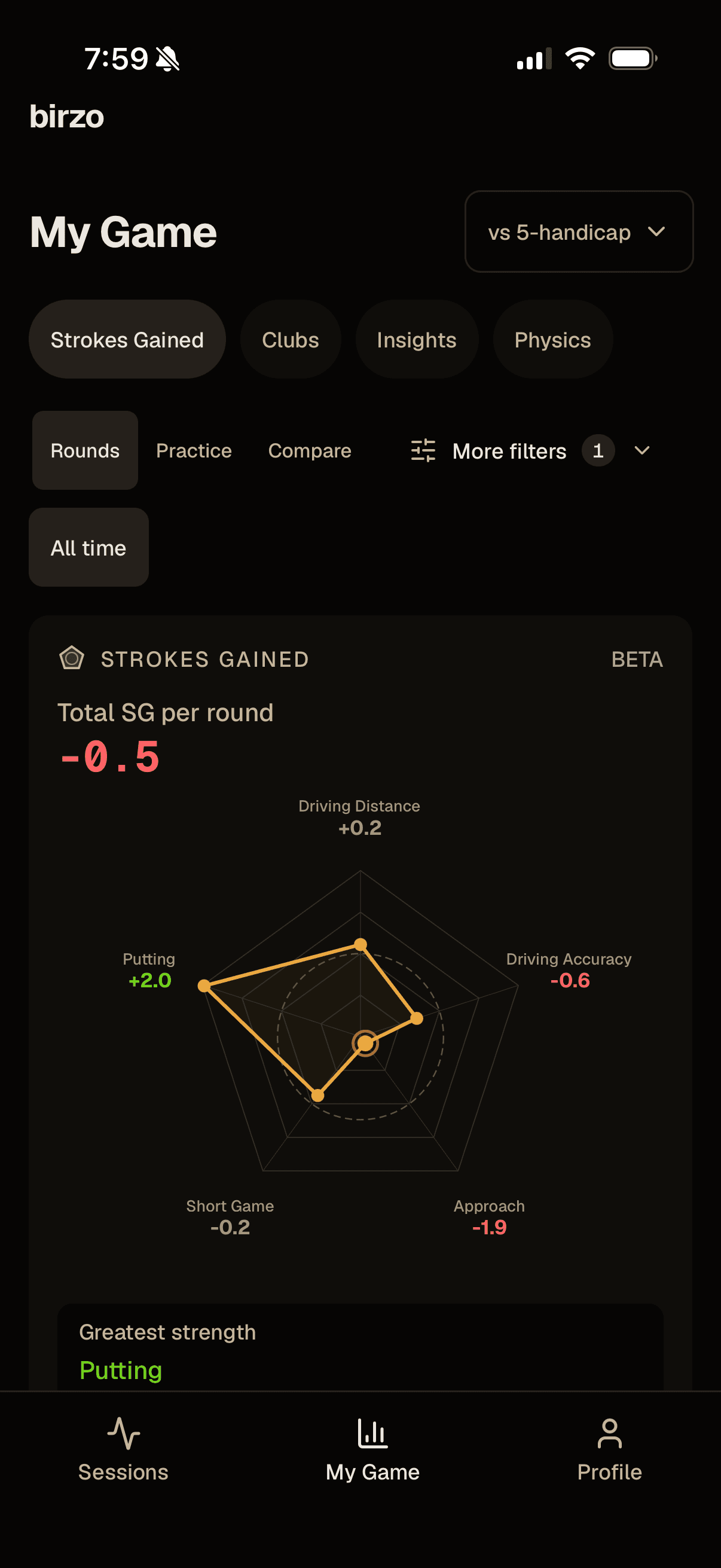
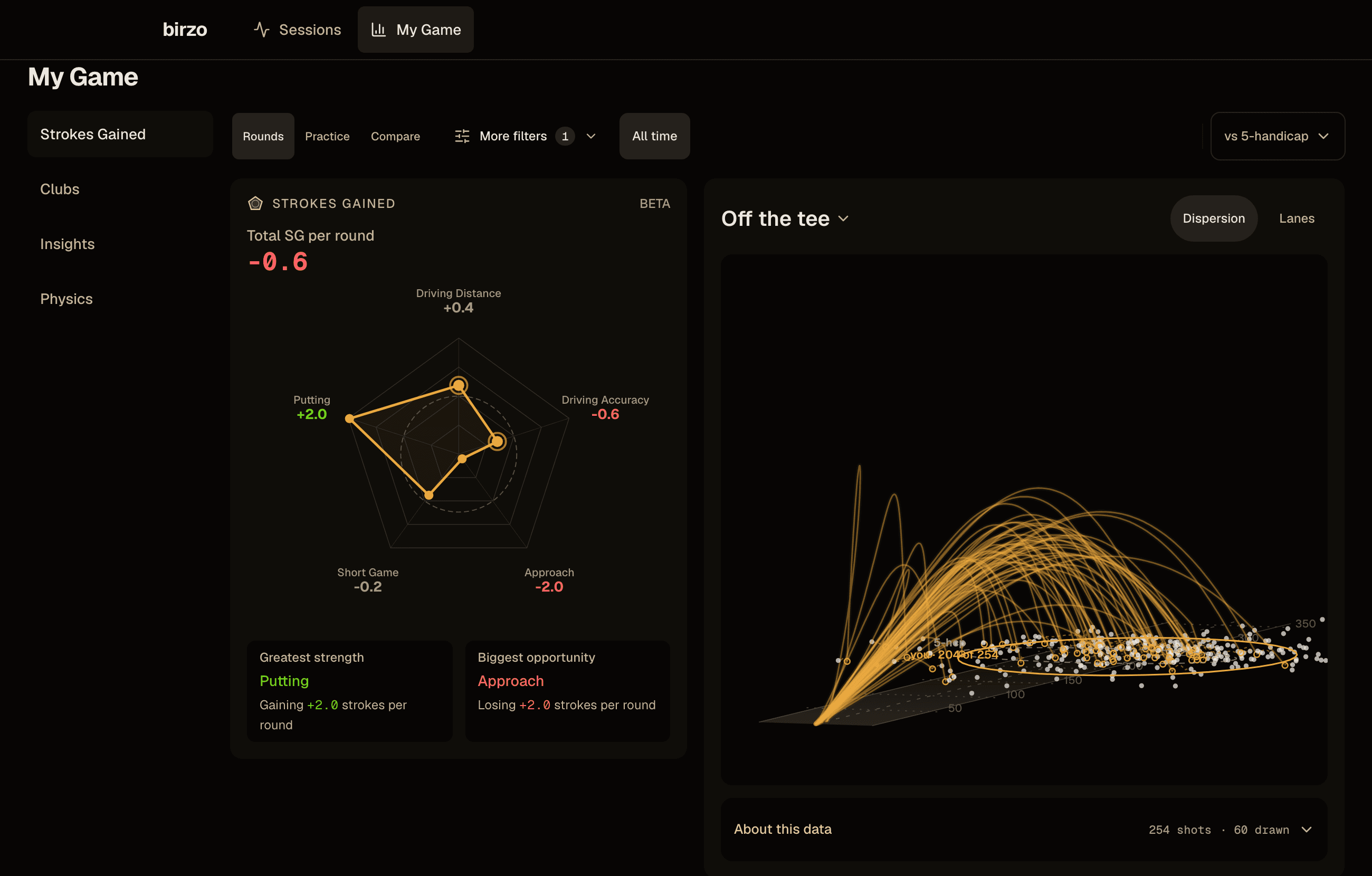
03 · Strokes gained

See where strokes hide.

Every shot measured against scratch, Tour, or your own handicap — your game sorted into where the strokes actually go.

Browse this live on the founder's account→

The Strokes Gained view on a phone

access your data from any device — iOS or web

The Strokes Gained view on the founder's real account — off the tee, dispersion drawn
The Strokes Gained view on a phone
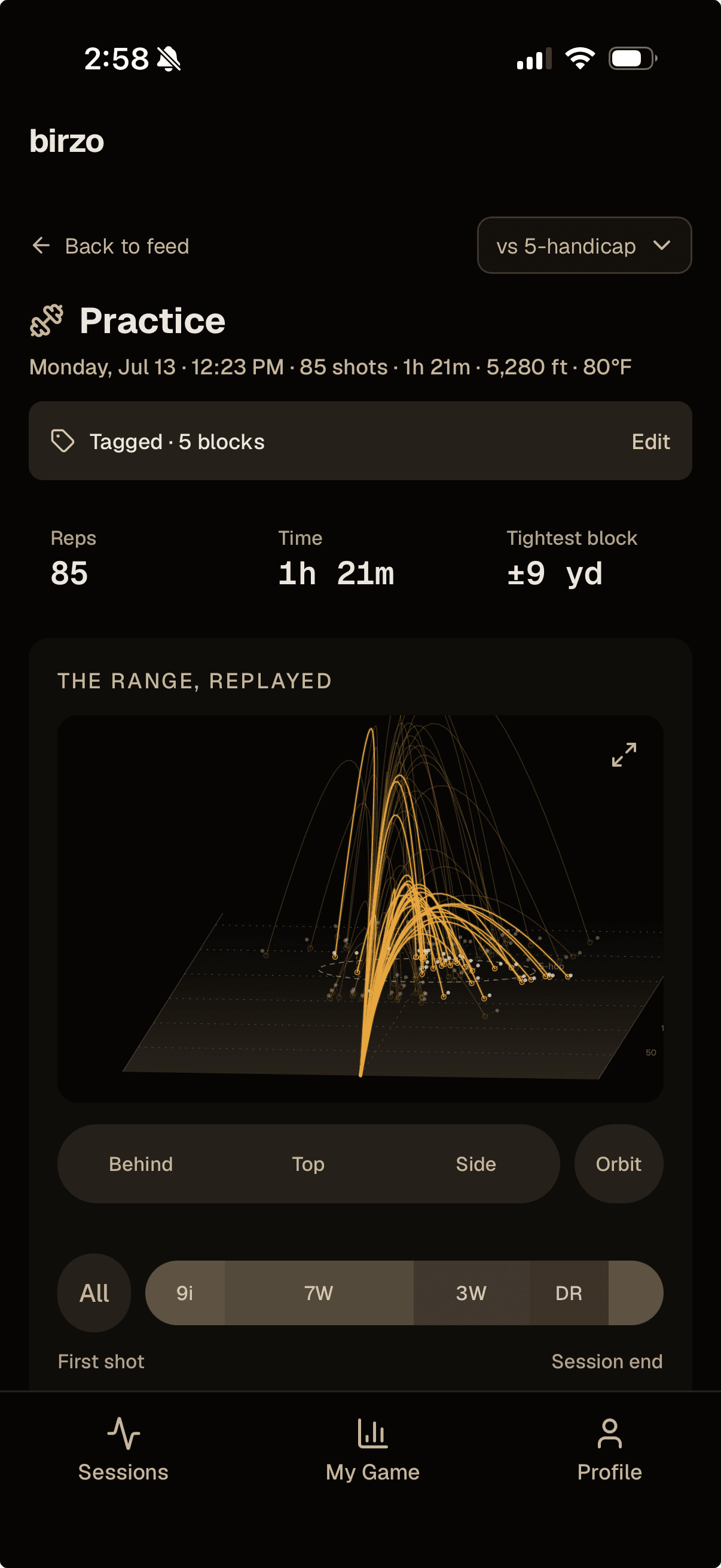
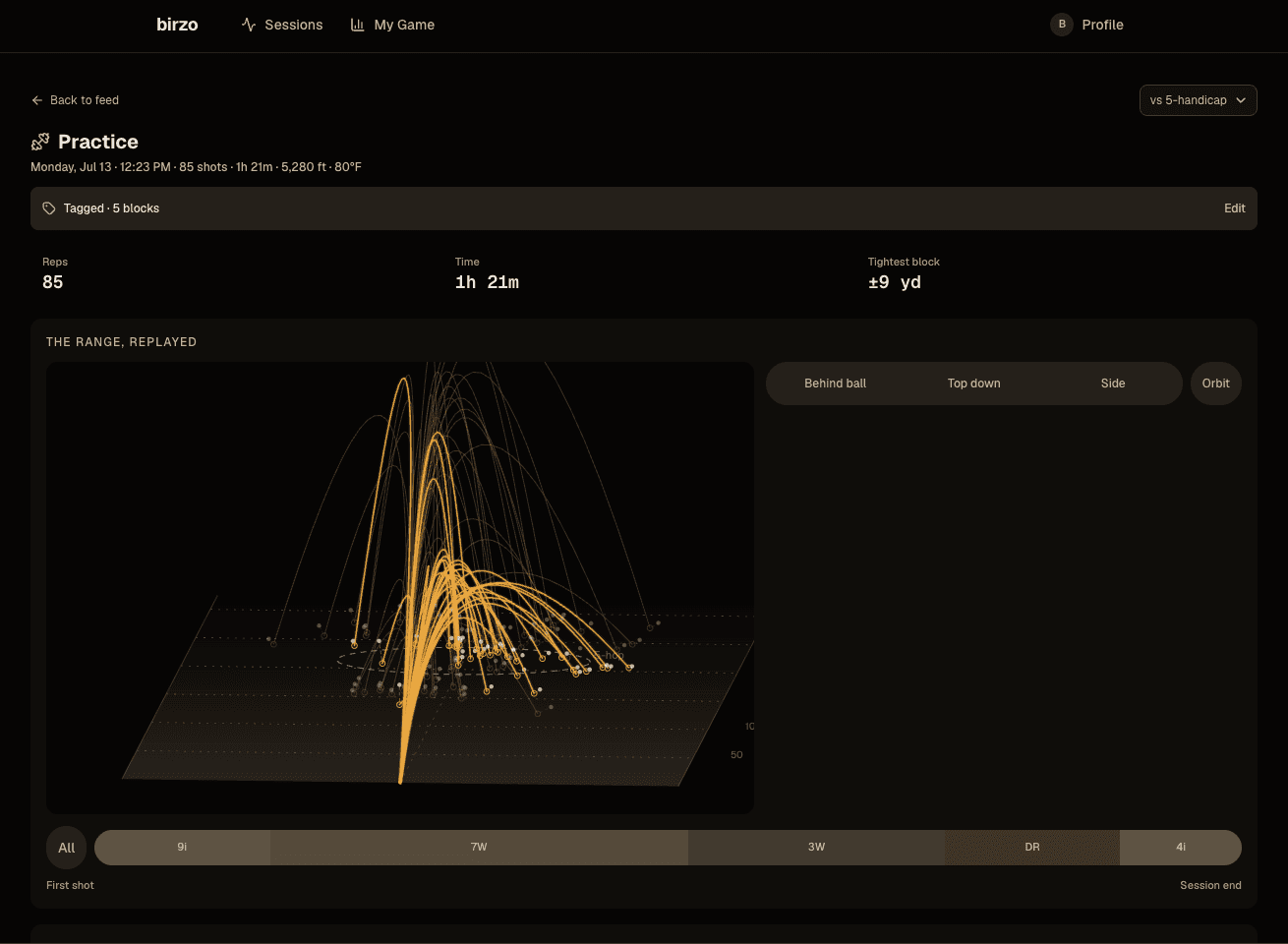
04 · Practice, replayed

The range, replayed.

Every range session banked shot by shot — walk back into the replay, your tagged blocks, and each club's true numbers building while you work.

Browse his practice sessions→

A practice session on a phone

access your data from any device — iOS or web

A real practice session on the founder's account — the range replay and per-club numbers
A practice session on a phone
05 · Your bag, mapped

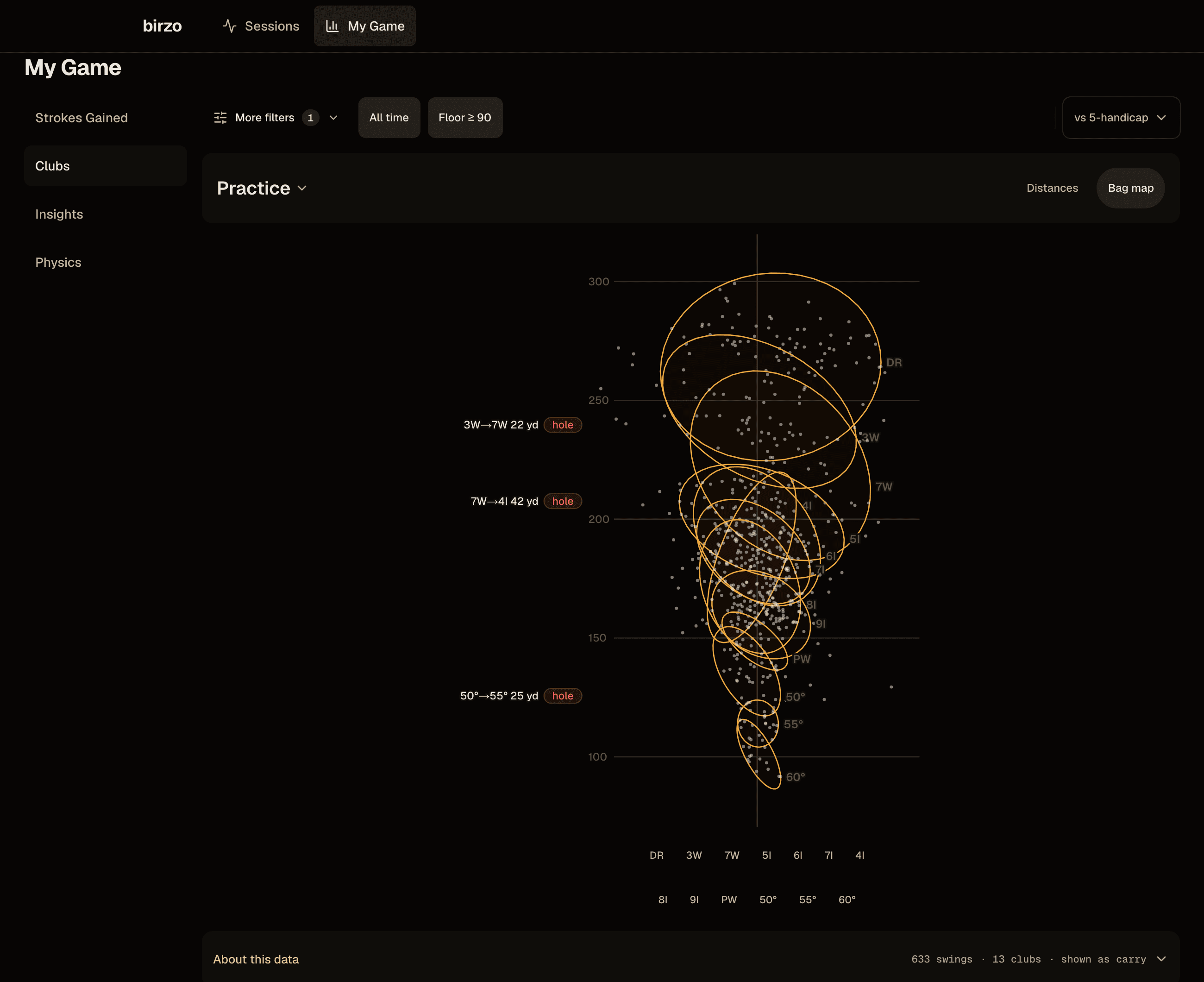
Every club's true window.

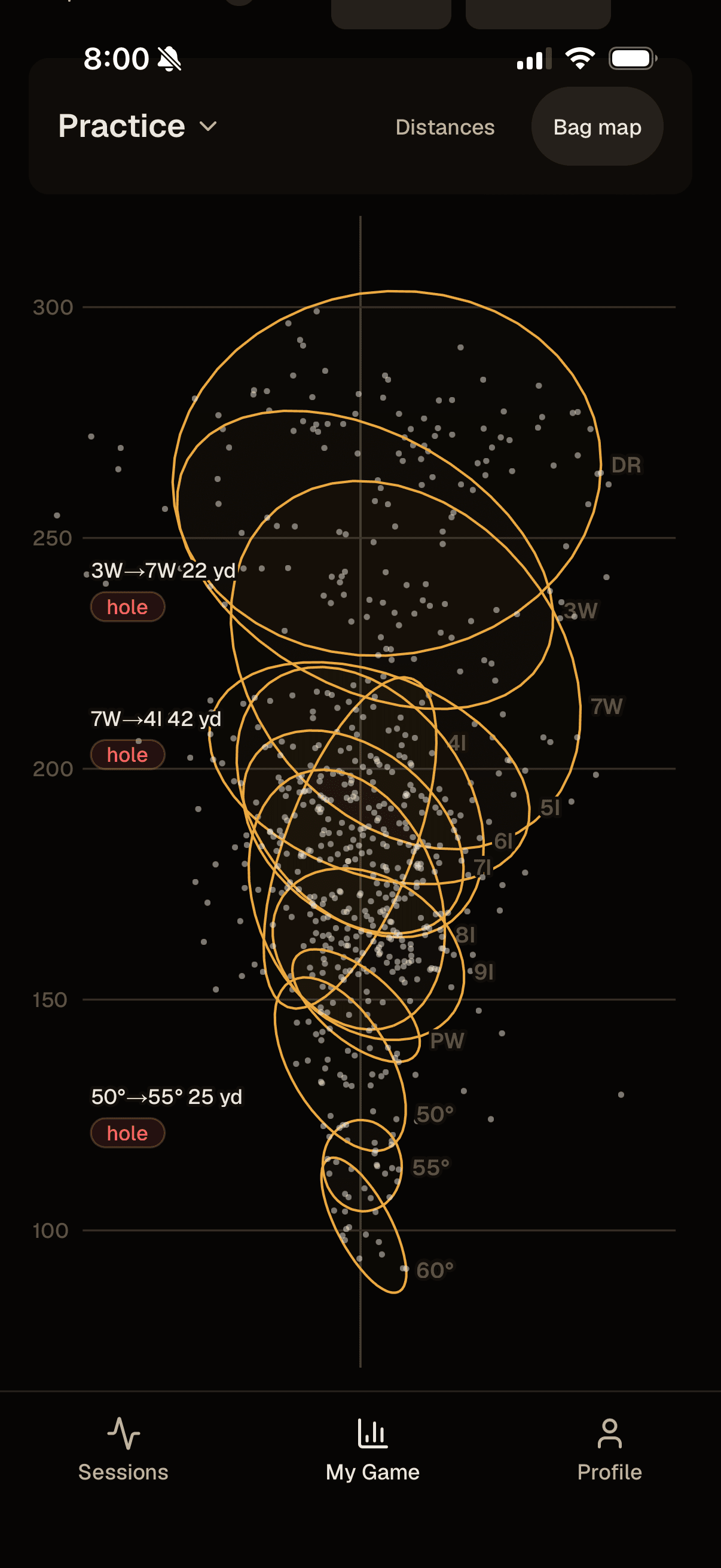
Each club's real carry and spread, laid down one fairway — the gaps show before they cost you.

See the live bag map→

The bag map on a phone

access your data from any device — iOS or web

The bag map on the founder's real account — practice scope
The bag map on a phone
06 · Swing camera — soon

Your swing, on tape.

Automatic recording coming soon.

How it works

Five minutes once. Automatic forever.

01

Play on your sim

GSPro, practice or rounds. Five-minute setup once — then Birzo lives in the background.

02

Every shot captured

All of it, automatically — every swing, every hole, every detail. A few taps of tagging when you want even sharper reads.

03

Your game, everywhere

iPhone and any browser, live during the session and after. Buddies tracked under their own names.

Free plan forever. Paid plans coming.

free · forever

  • Every shot captured automatically
  • Your real distances
  • Strokes gained — your pick of baseline
  • Live second screen during the session

pro

  • Trends across every session
  • AI insights
  • Cross-session intelligence

Your next session could be the first one banked.

Join the beta — free

Not ready? Browse the founder's real account first →

birzo

Every shot remembered. Every session measured.

Terms·Privacy

Questions? info@birzo.ai

© 2026 Birzo. All rights reserved.